Thursday, January 29, 2015

A Wonderful World


Wayne Higby 
at
The Memorial Art Gallery

A large scale exhibition is devoted to the work of one artist, the ceramics of Wayne Higby.  Now, the Memorial Art Gallery is beginning to present more artists associated with American craft and giving them due credit.  At the entrance to "Infinite Place" there are two or three ceramic plates and bowls with nearly monochromatic color and this sets the stage for the dramatic entrance of the landscape as the source of inspiration for the development of this artist's project.  At first, Wayne Higby's approach might seem a bit cartoonish, but this gives way to a more Asian aesthetic, and the process forming the clay seems to correspond to the spaces in Japanese screen painting and the way screens are meant to fold.

The medium might be earthenware, but the colors employed as glazes create a structure that can be easily identified.  It is not ironic that the materials for this artist's work are dug up from the ground, and the ground itself in the form of a larger landscape then becomes the  subject of the work.  A bowl made of raku fired clay portrays a landscape that inspired all this in the first place.  What is highlighted, is the artist's ability to transform a common material ( clay ) into something unique.


White Terrace Gap ( 1984 ) by Wayne Higby

When the ceramic artist leaves the realm of utilitarian ware, and begins to devote his efforts to a more decorative function ( as in the giant red wall tiles towards the back of the show ) the effect becomes more cerebral, but also still very visual and tactile.  These huge tiles remind me of microscopic photos of blood cells, or on the other extreme, photos of the cosmos and myriad stars out there in never-never land.


Lake Powell Recollection Falls, 1996, glazed porcelain
by
Wayne Higby

Wayne Higby has a long association with Alfred University, and many of the pieces in this show come from collections including the Smithsonian.  Some of the mini-landscapes in this show stand out like the one pictured above in glazed porcelain.  I am also taken with three small works on little angled shelves that engage the viewer by creating an interesting play on positive and negative space.  The artwork is small, but "Eidolon Creek" calls attention to this play between actual emptiness ( or negative space ) and foreground rocks    ( positive space ).

Down the hall from the art of Wayne Higby is the Lockhart Gallery and prints by Robert Kirschbaum.

These highly architectural prints form part of an alphabet and remind me of the art of Sol Lewitt.

The images are located in an isometric space and are essentially all linear, and very minimal.  Each letter is presented as an isolated artifact, and the artist's touch is logical and reductive.  The prints are small but striking in their black and white simplicity. 
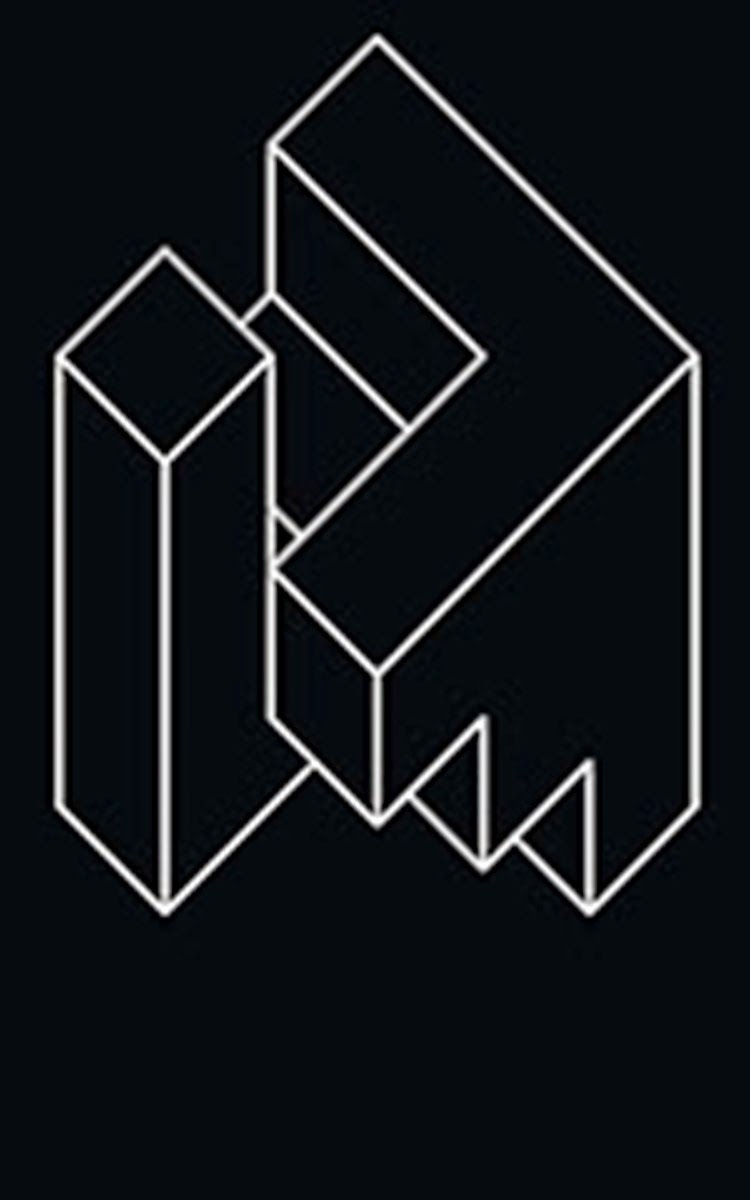

Rober Kirschbaum "The 42-Letter Name", 2009

Thursday, January 22, 2015

Compare And Contrast


Cornelis van Spaendonck, 1793 
at the 
Herbert F. Johnson Museum of Art

Cornell University

A lesson in Art History has been mounted ( I imagine it's intentional ) in the galleries of the Herbert F. Johnson Art Museum in Ithaca, on the Cornell University campus.  As I have written here before, my studio window looked out on this building as it was constructed, while I was concentrating on earning my MFA in Painting back in the early 1970's.  I still go back periodically to the museum to take in the shows and this time I could just hear my professors talking about the paintings on view just a few feet away.


Rembrandt drawing circa 1638-42
from 
The Leiden Collection


Dutch paintings from the Leiden Collection were a strong calling card, and this group demanded close attention.  There are also prints and drawings in this show most notably a small Rembrandt of a Lioness with a beautifully composed use of charcoal and a bit of grey wash with some white highlights.  The head of the animal is balanced on some rugged shading with a second thought or two evident in the artist's process especially around the forelegs.  Later, when I went downstairs the thought of contrast and comparison became clear, as I studied Philip Pearlstein's nude, after being immersed in the Dutch painting world of artists like Pieter de Hooch, and Gerrit Dou.


Brueghel the Younger
oil on panel, 1592

The scandalous painting from Brueghel the Younger, a circular oil on panel has the title " He Who Holds The Sack Of Gold Will Always Have Flatterers".  I don't recall seeing this in my art history books!  It has the substance of a modern artist ( like Peter Saul maybe? ) but it also has the paint handling and classic touch of a different era.  Thinking about this, I look at the flower painting at the top by Spaendonck, and I say - How Did They Do This?  Without the crutch of the ever-present photo reference ( or as my students use it - their Smartphones ) - these master painters must have had photographic memories, and they trusted their sense of form, light and shadow, and all kinds of ability to render what they saw.  And there is always a bit of theatre in all of their work.


From the Leiden Collection

When I went downstairs to see the contemporary art, the Dutch painters still echo in my mind.
Phillip Pearlstein's nude has some of that classic approach to figure painting, but on a much expanded scale, and in a spare, almost minimal setting, even the play of light tries to strip away any sense of the theatrical, and just makes as plain a presentation of the artist's skills as it can be.  


"Seated Nude on Bentwood Chair" by Phillip Pearlstein, 1967

The Johnson Museum has created a new look for their galleries, especially with more recent art on display.  After looking at the Dutch paintings one can compare their skillful determination with a photo-realist like Ralph Goings.  His pick-up truck from 1973 has a matter-of-fact realism that communicates what things look like in the documentary style of the time and this shares something with the Pearlstein process, strip away the stories, and narratives from the past and show things just as they are, or as William Carlos Williams writes: " No ideas but in things".


Ralph Goings, Acrylic on canvas, 1973

The figure is the important subject in the latest re-hanging of paintings in the Harris Gallery at the Johnson Museum.  There one can look at fine examples of modern art from Leger, and Giacometti to 
Wayne Thiebaud and Milton Avery.  If I were a student today, this is the place I would use as my compass to get my bearings, it was a very pleasant visit to the museum!


Alberto Giacometti at the Herbert F.Johnson Museum of Art

Tuesday, January 20, 2015

Coming Full Circle


Check out my interview in the latest issue of "ARTiculAction


To the readers of this blog, I say,  Thank You!  We now have over 25,000 page views, and I appreciate the time you spend looking over what I have to say from time to time.  I have been working in the Fine Arts for over forty years, as an artist and writer, and now teacher.  I have published in books and magazines and now on the WEB.  Just this month a recent publication is  carrying an interview with me and is presenting some of my new artwork, so if you want to know more about the person who writes this blog, check out my interview in this new magazine ARTiculAction.  Here is the link:

Wednesday, January 14, 2015

The Movie Puts On A Show


Henri Matisse, 1953

Anna and I have taken to going to hear the Metropolitan Opera at our local movie theatre from time to time. A really big screen for an opera certainly beats listening to it on a radio as I have done when I can on the weekend.  At the movie theatre the opera comes alive with careful camera work, and at intermission we get a chance to hear live interviews with principal cast members - what's not to like?

So last night we found ourselves at the movie theatre again, but this time to see something very different, and my guess is that it was not well publicized because there were only a few people in the audience on a Tuesday night.  But we were the lucky ones to have a guided tour through an art exhibition - The Matisse Cut-outs to be precise - and the show was terrific!


The Snail

For those of us who could not get to The Tate in London, the Matisse show will be in New York City until early February, so there is still some time...  But the film we saw was much more than a guided tour through the rooms at the Tate, and to a lesser degree, the Museum of Modern Art in New York City.  The movie tells us much more about the curators and directors of each institution - in this case Nicholas Serota is very impressive with his ability to shape the show that we see especially in a challenging room of "Blue Nudes"at the Tate in London.


Henri Matisse with his color papers on the wall

The movie also includes special music to go with Matisse's book called "Jazz", and there is also a stunning dance sequence with Zenaida Yanowsky from the Royal Ballet to savor.  I loved the historical footage of Matisse at work with a pair of scissors, and the first person dialog with Matisse's assistant, and also with Francoise Gilot who was with Pablo Picasso during this period.


So, if you can't get to see the exhibitions, at least there is this fine movie to take in, and you'll be glad you did.


Zulma by Henri Matisse. 1950

Saturday, January 10, 2015

WHAT Did You Say?


"HYPE"
Jihwan Park in his exhibition is called "Latency"
at the Brainery,
 The Village Gate, Rochester, NY

In the wake of the massacre of writers and cartoonists at the publication "Charlie Hebdo" in Paris this week, I hope people will stop and think about what they say and how it effects others.  WORDS MATTER.  In the art world, there is a broad spectrum of visual expression that seems to be inclusive, but it also challenges you to think.  Making a political statement within a context of fine art is nothing new, look at Daumier for example, or a more contemporary artist like Sue Coe.  Another example might be in a show called "Latency" that just opened by Jihwan Park at the Mind/Matter Gallery in the Rochester Brainery over at the Village Gate on North Goodman Street, in Rochester, NY.

The Brainery is an educational institution that originated in my old neighborhood of Brooklyn, New York.  They give classes now in Rochester as well, and they have exhibitions like this one from January 2 to the 31st, 2015.  Jihwan Park came to study at Rochester Institute of Technology leaving Seoul, South Korea for his graduate art education ( MFA ).  Jihwan has an impressive portfolio of architectural projects to his credit, yet he wanted to do something with a more personal impact.


Jihwan Park at work 
in Seoul, South Korea

When you go see his show - start with viewing the documentary film about his "Armored Vehicle Project".  You might miss it - but in the opening dialog of this edgy film you get a bit of the background story that called into creation this piece of performance art from Jihwan.  This project came as a response to the deaths of two civilians run over by a military vehicle.  The driver of the military vehicle was exonerated.  Jihwan Park got personally involved when he created his own "armored vehicle" covered in gloves that were pasted to the outside, and then he staged an accident in the street that brought to attention the injustice that occurred over the original incident with the military.

What is difficult with this kind of demonstration is that it runs smack up against authorities ( the police for example ) who don't take this kind of freedom of expression very lightly.  In the United States we had some of the same response to demonstrations against the Vietnam War, and also for civil rights, among other incidents in our history.  What Jihwan Park is doing is raising our awareness and engaging us in a deeper - more radical form of expression - where the rubber meets the road! He makes this quite clear in other works of art that make up his exhibition including sculptural installations at The Brainery.


Jihwan Park at The Brainery

Jihwan's art is physical, as well as intellectual.  His "Broken Art" series is his articulate response to having his work trampled on.  He takes familiar paintings from art history - for example The word LOVE from Robert Indiana that comes from POP Art or see  ( the quote from a Roy Lichtenstein above ) and uses these images in a way that is calculated to get a response.  The painting is literally torn apart, but the fundamental structure of ART still remains.  


Jihwan's art is physical as well as intellectual
here his installation sheds light on his painting of a chandelier

Wednesday, December 31, 2014

Far Out Man


ROBOLIGHTS
by
Kenny Irwin Jr.

1077 Granvia Valmonte,
Palm Springs, CA.
5$ donation at the gate

Kenny Irwin has created his own amusement park and my stay in Palm Springs would not be complete if I didn't go for a visit.  Some people have to go and see the Bob Hope house, but don't miss this - this is too much!

Robolights, a 4 acre site, not far from Frank Sinatra Way in a palmy suburb, was where I found an amazing array of folk art from the hands of one very driven person who has a vision and will not stop until every nook and cranny is filled...  did anyone say "obsession? "


Alan Singer gathers materials for the
blog you are reading

If you grew up playing with Legos, Transformers and other mechanical mayhem, this perpetual show will be right up your alley.  Especially captivating were the stags emerging from a line of toilets in a central square where a huge golden stage coach was parked and instead of a team of horses pulling the carriage, we have a fleet of yellow manikins.


Kenny Irwin Jr. has been developing this park on the family estate for many years.
Around every corner there is something to marvel at.

This personal theme park has been built by hand ( maybe with the exception of the Macy's balloon parade which floats above parts of the constructions).  Private tours can be arranged by appointment and if you just want to stay a little while you can make a donation at the front.  Your money literally goes down the drain, and you can proceed on the paths towards the end.  Look up and you will see millions of lights!

I think the artist must have grown up watching old Pee Wee's Playhouse reruns.  My friend Gary Panter would no doubt approve, since he designed many of the crazy props for Pee Wee's sets.  But you haven't seen anything quite like this - are you ready for it?


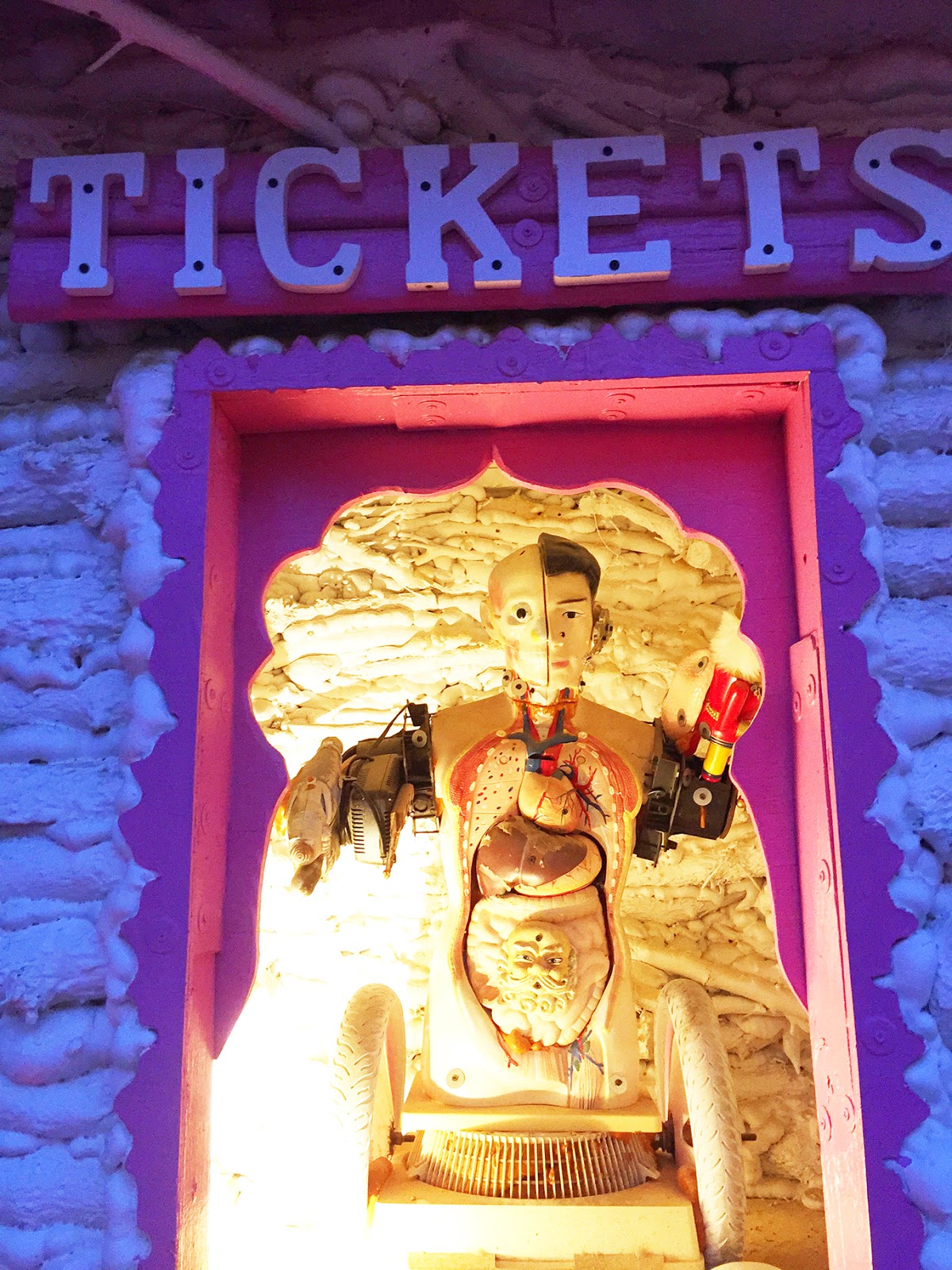
Many of the constructions have been put together with cast-off collections, old pails, skulls, and odd assortments of lumber painted in the brightest colors.  There is a carousel of sorts, a mad green whirling head, and an anatomical ticket taker and so much more.  Plan to stay after dusk, the place is truly a Coney Island of the Mind!


Tuesday, December 30, 2014

Way Out West


2015, Welcome the New Year
at
Palm Springs Art Museum
Palm Springs, California

There is a chill in the air on a sunny day in December.  We're in Palm Springs and we walk up the steps to the museum.

Palm Springs has doubled in size since we were last in these precincts, and this is the busy time of the year here.  I am looking up at the banners outside the museum advertising the shows of contemporary glass, and the special exhibition from the studio of the Chinese artist Ai Wei Wei.

Yesterday, we walked around Joshua Tree National Park and it features views with a fascinating geology that goes for miles and miles, and today we are taking in a different form of visual culture.  Walking up to the museum we are greeted in the  sculpture gardens with  works by Henry Moore and Barbara Hepworth among others.

There is a traveling show of Australian modern glass called "LINKS" which looks enticing. We go upstairs in the elevator and begin our tour seeing manipulated photos and gazing out over the atrium.


Atrium of the Palm Springs Art Museum

We take in the paintings by Anselm Keifer, Helen Frankenthaler, Ellsworth Kelly, and a convex circle by Anish Kapoor. There is a dress made in 1964 at the Andy Warhol studio of a Brillo Box and some printed yellow cloth.  One of my favorite works on the upper floor was a  "quadtych" by Brian Wills of a spectrum consisting of four parallel wooden shelves surrounded by color threads.


Horizontal Spectrum by Brian Wills, 2013

There was a big operatic painting by Jennifer Bartlett " Fire, Table, Cone" from 1988-89 that has some staying power with the actual objects of a orange red table and black cone placed in front of the painted images being consumed by flames.  Is this an allegory of how forms are used up in the art world? Forms are used and then re-invented or re-packaged as seen downstairs in the horoscope of heads by the Chinese artist Ai Wei Wei.


Tableaux of Cone, Table and Painting by
Jennifer Bartlett
1988-89

We sat and watched a short video about the sculpture of Ai Wei Wei, and had a look into his studio practice as the horoscope heads were being built by his studio assistants.  Clay models were being cast and two editions were made: one in bronze and one in gold.  On view at the Palm Springs Art Museum were a set of twelve heads in gold - each on a pedestal. They were effective as a group and as individual pieces, to a greater or lesser extent - each person may have a favorite…


Ai Wei Wei

As far as studio production goes, these twelve heads were interesting, and the set helps to place where Chinese contemporary art happens to be at the moment.  Ai Wei Wei may be the most well-known Chinese artist, and that may be due to his activism, and all the controversy surrounding his house arrest.

The horoscope heads are not consistent, in terms of style and impact.. some of the "necks" are more interesting, some of the descriptive heads are better, some are a bit slick, and remind me of certain characters in children's literature.   Never-the-less I am happy to have seen this set.


Acoma ceramic pot

There is a section of the museum dedicated to paintings of the Southwest, and there was a favorite small study by Thomas Moran of the Grand Canyon.  Also on view: a selection of Navajo pottery, and weavings, like this pictorial Germantown blanket circa 1880.


Germantown Textile, circa 1880

Contemporary glass is all fired up!  The show at Palm Springs Art Museum features Australian glass art and it is simply beautiful.  Also it is inventive, and subtle, and striking, especially in the way the show titled: LINKS is mounted.  Every piece of glass in the exhibition is given space to breathe ( which is one thing missing from many of the shows I have seen at Corning for example ).  There are glass panels that look like paintings, and there are several striking images that are minimal and essential.

Giles Bettison creates patterns in the glassworks he makes and I found this one striking for its subtle color range.  There is a interesting story to tell with these new Australian glass artists.


Giles Bettison
glass art with textile patterns, 2010